

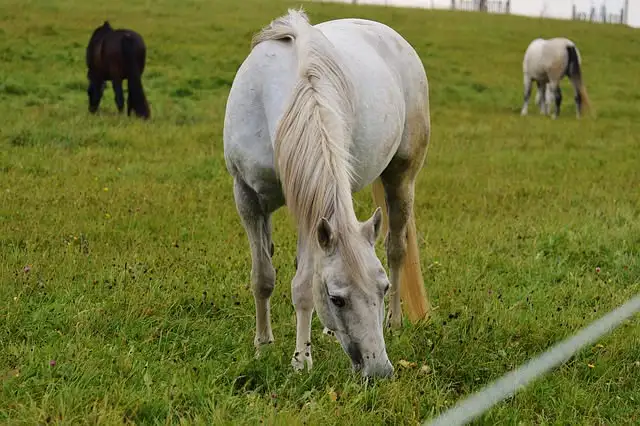
Spring is finally in the air and the green of new grass is a pleasure to behold… But wait, my horses are looking at it fondly too! Much too fondly…After a long winter on a mainly hay diet with fewer opportunities for exercise, that lush green grass may be a bit too much for horses to handle all at once. Let’s look at some important pointers to keep in mind to keep our equine partners healthy and comfortable as they begin to enjoy the shift of seasons.
In the wild, horses not only stay on the move rather continuously but at this time of year are grazing on very fibrous and low-carb range grasses and brush that are still in the state of winterkill. As domesticated animals, their diet likely has changed little from season to season, and they may have built up a load of stored energy over the winter that looks remarkably like fat, so their nutritional status is at higher risk from overload when first turned out into that irresistible green pasture.
Pointer #1: Time of growth – According to Penn State Extension service, it is best to wait until pastures have grown to a length of at least 6 inches before grazing so that the plants have adequate time to recover from winter and grow new leaf tissue.1 Once the pastures have grown enough, begin with short grazing periods for the first few days (15-30 minutes per day). Slowly increase the grazing time by 15-30 minutes per day until the horse is grazing for 3-4 hours daily. Continue this time period for another week or two before changing over to your desired daily turnout time.2 Timing your turnouts after feeding hay or daily grain concentrates assures that the horse is not very hungry when it is offered grass. Remember that horses who are known to be sensitive to grass, prone to laminitis or with a metabolic syndrome may need longer to adapt, may need a grazing muzzle or may require more limited grazing time or no access to grass at all.
Pointer #2: Time of day – Understanding the daily rhythms of grasses is a prime factor in keeping our horses healthy. Grasses produce a number of non-structural carbohydrates (NSC) in the form of sugars, fructans and starch when exposed to sunlight. These are stored in increasing amounts during daylight hours so that they can use them for sustenance during the nighttime hours. The sweetest tasting grass will be in the late afternoon with the lowest sugar content of grass occurring in the early morning hours, specifically from 3am to around 10am. This daily cycle repeats itself with increasing intensity as the days lengthen through late spring and summer. Remember grazing times should be very short and confined to the lowest carbohydrate dense hours, around mid-morning. A well-fitting, comfortable grazing muzzle is an excellent idea for those equines who are known to be sensitive to grasses, overweight, or have metabolic issues.
Pointer #3: Time for Feet – Over the winter, a horse’s hoof often grows more slowly as their primary energy expenditure is for body warmth. As the amount of daylight hours increases and the days get longer, the horses shed their winter coat, rapidly replace it with short summer hair and extra energy goes into hoof growth. Additionally, wet muddy paddocks place greater stress on horses’ hooves if the outer walls have grown long and splayed outward in an effort to stabilize the horses’ weight in soft mushy footing. Stay current with your trimming or shoeing routine to prevent the leveraged stress that can create separation between outer layers of the hoof wall and the inner layer.2 If this distortion in the hoof develops it can lead to a separation of the white line, which creates an opportunistic environment for bacteria and can be the perfect environment for abscesses.2
Keeping in mind these three important concepts will help you and your equine partners enjoy the warmth of the coming season and reap the maximum benefit from the good green earth.
By C Jane Burrows
RESOURCES:
1. Laura Kenny(2025, Jan 10). Transitioning Horses to Spring Grazing – PennState Extension.